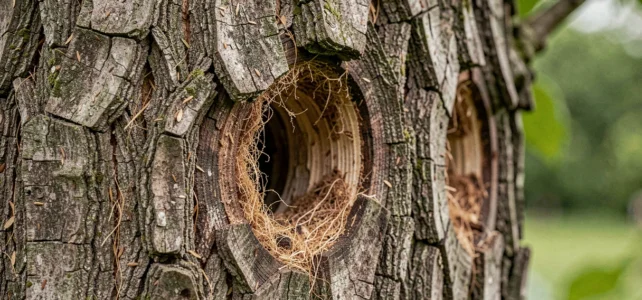
The xylotrechus stebbingi is a longhorn beetle from the Cerambycidae family, native to South Asia. Its larvae develop in the living wood of plane mulberry trees (Morus kagayamae), where they burrow galleries that weaken the internal structure of the trunk and main branches. Detecting its presence early and acting according to current recommendations is crucial for the survival of the tree.
Galleries, sawdust, and emergence holes: recognizing an attack by xylotrechus
The first visible sign is often fine light sawdust, compacted into small rolls, at the base of the trunk or in the crevices of the bark. This sawdust comes from the work of the larvae as they progress through the wood.
Emergence holes then appear. These are oval openings, a few millimeters in diameter, drilled into the bark by adults when they leave the tree. Their presence on the trunk confirms that the beetle’s development cycle has completed at least once in the tree.
A third sign deserves attention: localized dieback of branches, sometimes on just one side of the crown. The galleries interrupt the flow of sap, causing gradual drying out. A plane mulberry tree with a main branch that suddenly dries out in the middle of the growing season should be closely inspected.
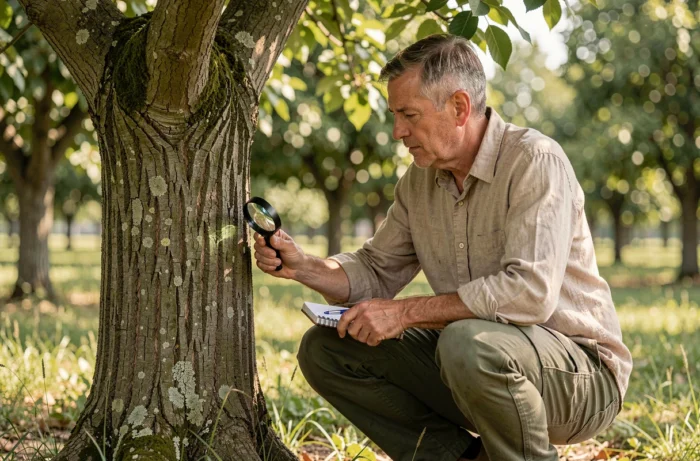
The distinction from other wood-boring insects (longhorns, bark beetles) relies on the combination of these signs and the identification of the adult insect, recognizable by its light bands on the pronotum and elytra. In case of doubt, a photo sent to the regional FREDON or to an entomologist can confirm the species.
It is useful to know what to do when facing xylotrechus stebbingi at the first signs, as early intervention limits the spread to neighboring trees.
Felling, scraping, or pruning: mechanical management options recommended by ANSES
In 2024, ANSES updated its management recommendations for the tiger longhorn in non-agricultural settings, through a specific notice (request 2023-SA-0028). This document clearly ranks the possible interventions on ornamental trees in urban and peri-urban environments.
Felling as a priority measure
Felling remains the reference measure as soon as emergence holes are visible on the trunk. The goal is to eliminate the larvae still present in the wood before they complete their cycle and colonize other trees.
ANSES specifies that the products resulting from felling must be shredded into fragments smaller than 50 mm in all dimensions. This size prevents the survival of larvae in the wood residues. Traceability of the shredded material is required: it must not be stored near other mulberry trees or sensitive species.
Scraping and targeted pruning
When the infestation is localized to one or two branches, scraping (removal of infested wood) or selective pruning can replace felling. This option requires a thorough inspection to ensure that the main trunk is not affected.
The removed wood follows the same rule: fine shredding and traceability of the shredded material. Open-air burning is explicitly ruled out by ANSES, even as part of the fight against a harmful organism, in accordance with the circular of November 18, 2011, which prohibits this practice.
Insecticides against xylotrechus: limited effectiveness and regulatory constraints
ANSES’s notice mentions the possibility of using systemic or contact insecticides, but with a clear caveat: their total effectiveness has never been demonstrated against this pest. The larvae develop deep within the wood, out of reach of most products sprayed on the surface.
In urban areas, the environmental and societal impact of chemical treatments poses an additional problem. Gardens, parks, and street alignments host pollinators, beneficial insects, and users. A broad-spectrum insecticide treatment can cause disproportionate collateral damage compared to the expected benefit on buried larvae.
In practice, if a professional proposes a chemical treatment as the sole solution, caution is warranted. Official recommendations prioritize mechanical management. A treatment may eventually complement pruning or scraping, but it does not replace them.
Reporting in infested municipalities: what changes for individuals
In the southern regions of France where xylotrechus is already established, the reporting logic has evolved. Several municipalities categorized as “infested zone” no longer require individual declarations of each affected tree. The presence of the insect is considered established there.
For individuals located outside these zones, reporting remains useful. Here are the steps to follow:
- Photograph the emergence holes, sawdust, and, if possible, the adult insect, placing a reference object (coin) for scale
- Send the photos to the FREDON of your region, which ensures monitoring and species confirmation for wood-boring beetles
- Contact the green spaces service of your municipality, which can coordinate the intervention and direct you to a professional for pruning or felling
Early detection in an area not yet listed as infested helps limit the geographical spread of the pest. A tree reported quickly can be treated before adults emerge and disperse the population.
Replanting after felling: alternative species to the plane mulberry
Replacing a felled plane mulberry with another plane mulberry exposes the new tree to the same risk. In areas where the presence of xylotrechus is confirmed, choosing a non-host species reduces pest pressure on the neighborhood.
Municipalities that have carried out massive felling are turning to Mediterranean species resistant to drought and not targeted by this cerambycidae: hackberry, Judas tree, evergreen oak, or soap tree. These species provide comparable shading in the long term, without serving as a reservoir for the pest.
A healthy plane mulberry in an isolated garden, far from any known outbreak, does not justify preventive felling. Regular monitoring of the trunk (two to three times a year, especially between May and September when adults are active) remains the best approach to intervene before the infestation becomes irreversible.