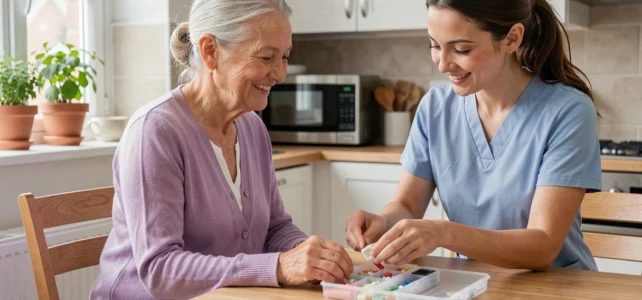
The landscape of services for the elderly in France is undergoing a silent transformation. Since 2023, a reform has restructured all home assistance around a single category, the home autonomy service (SAD), which redefines what a caregiver can do and where they can do it. This administrative transformation has very concrete consequences for the daily lives of seniors, far beyond a simple change of acronym.
Home autonomy service: what the SAD reform changes for seniors
Before the reform, three structures coexisted: SAAD (assistance), SSIAD (nursing care), and SPASAD (mixed). Decree No. 2023-608 of July 13, 2023, gradually merges them into two forms: SAD assistance and mixed SAD. The goal is to simplify the process for families and avoid the multiplication of contacts.
A decree from July 7, 2024, expands the scope of interventions. Services are no longer limited to the strict home environment. Shopping, outings for leisure, or civic life are now included, provided they remain within the notified aid plan.
For current beneficiaries of the APA, nothing changes regarding procedures: existing contracts and rights are maintained. At the same time, the services offered by Seniors du Monde cover a range of complementary needs, from social connections to adapted activities. The services concerned must sign their multi-year objectives and means contract with the departmental council and the ARS before December 31, 2026.
Tax credit and home APA: the real funding of senior services
The personalized autonomy allowance (APA) remains the main funding lever for seniors losing autonomy living at home. It covers part of the hours of assistance, meal delivery, or teleassistance, according to a care plan evaluated by the departmental medico-social team.
The tax credit for employing a home employee represents the other central mechanism. It applies to individuals who directly employ a caregiver or go through a service provider. The tax credit also works for non-taxable retirees, in the form of a payment from the public treasury.
Field feedback varies on one point: the actual out-of-pocket expenses after combining the APA and the tax credit vary significantly from one department to another, depending on the ceilings applied and the rates negotiated locally. An hour of home assistance does not cost the same depending on whether the service is authorized or accredited, and according to the pricing grid of the departmental council.
Expenses covered by the APA
- The intervention of a home aide for daily activities (bathing, dressing, meal preparation, housing maintenance)
- Meal delivery, teleassistance, and hygiene supplies, within the limits of the aid plan
- Transport costs to a day center for individuals with cognitive disorders, when the service includes this provision
- Technical adaptation of the home (grab bars, lighted pathways), sometimes in addition to aids from Anah
Teleassistance and connected objects: senior services in full transformation
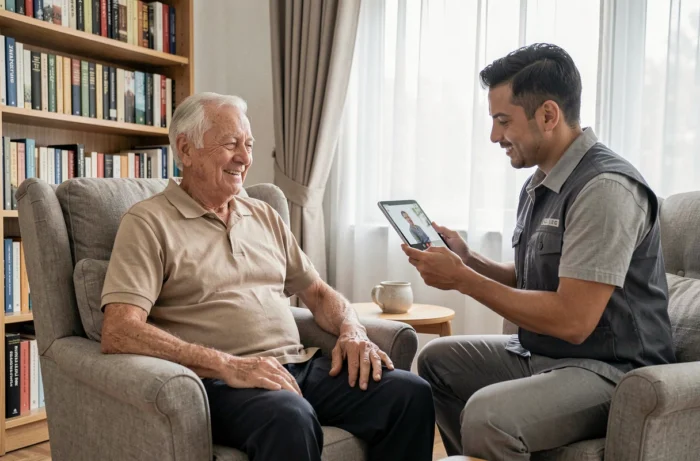
Classic teleassistance (medallion or bracelet connected to a listening center) has existed for decades. What is evolving is the integration of sensors and artificial intelligence into these devices. Some European cities, like Madrid, are already deploying advanced teleassistance using AI to detect anomalies in living habits and trigger preventive alerts.
In France, the CNSA supports innovative projects in the medico-social field. Several initiatives focus on environmental sensors capable of detecting a fall, a prolonged absence of movement, or temperature variations in the home. These devices complement human intervention without replacing it.
Current limits of connected health for seniors
The available data do not allow for conclusions about the large-scale effectiveness of these technologies in France. Experiments remain localized, and field feedback varies on acceptability by the elderly themselves. The main issue remains the digital divide: a significant portion of seniors do not have a stable internet connection or do not master digital interfaces.
The cost of these connected solutions is also a concern. While basic teleassistance can be covered by the APA, advanced devices (multiple sensors, analysis platform) often exceed the aid ceilings. The economic model of these services is still under construction.

Isolation of seniors: when social connection becomes a service in its own right
Isolation affects a concerning proportion of elderly people in France. It is not just a comfort issue: social isolation accelerates the loss of autonomy and exacerbates existing pathologies. Several institutional and associative actors are now structuring responses in the form of identified services.
Meal delivery, for example, serves a dual function. Beyond nutrition, the daily visit from a delivery person constitutes regular human contact and a point of vigilance. Home visit services, offered by associations or operators like La Poste, operate on the same principle: a regular exchange that allows for the detection of a change in condition.
Day centers, aimed particularly at individuals with Alzheimer’s disease, combine cognitive stimulation and social connection. Transport to these facilities can be included in the service, but this is not always the case. Checking this point before registration avoids logistical complications for families.
The SAD reform, by integrating outings and civic activities into the scope of fundable interventions, officially recognizes that maintaining social connections is part of care. This regulatory evolution reflects a change in perspective: accompanying a senior to the market or to a community activity is no longer seen as comfort, but as a genuine lever for autonomy.
The regulatory framework is evolving, technologies are advancing, and funding is being restructured. For seniors and their loved ones, the challenge remains navigating these systems. Knowing about the existence of the SAD, checking the items covered by the APA, assessing the relevance of advanced teleassistance: each situation requires its own analysis, which neither an administrative form nor an algorithm can yet completely replace.