
You’re pedalling along through the forest when the Rockrider E-ST 100’s assistance suddenly cuts out, turning the nearly 25-kilogram mountain bike into a dead weight to push uphill. Many owners of this Decathlon e-MTB know the scenario. Identifying the problem before heading to the workshop can often save time and sometimes even let you fix it yourself.
Assistance cuts out on climbs: an overheating controller
The most commonly reported issue in Rockrider E-ST 100 user groups is a sudden loss of assistance after around 20 minutes of sustained effort, especially in mode 3. You pedal, the motor kicks in, then nothing. The display stays on, but the assistance no longer responds.
This behaviour points to an overheating electronic controller. Housed in the frame, this unit manages the power sent to the motor. When the temperature gets too high, a safety feature cuts the power to protect the component.
In practice, when diagnosing a Rockrider E-ST 100 fault involving intermittent cut-outs, the controller is one of the first things to check. Stopping the bike for about ten minutes is usually enough to restore assistance, but the problem returns when the same conditions arise (a long climb, high outdoor temperatures, or continuous use of a high assistance mode).
Switching between modes 1 and 2 on climbs reduces the load on the controller. If the cut-outs continue even at low assistance, take the bike to a Decathlon workshop to have the component checked and, if necessary, replaced under warranty.
Rockrider E-ST 100 battery: loose connections and reduced range
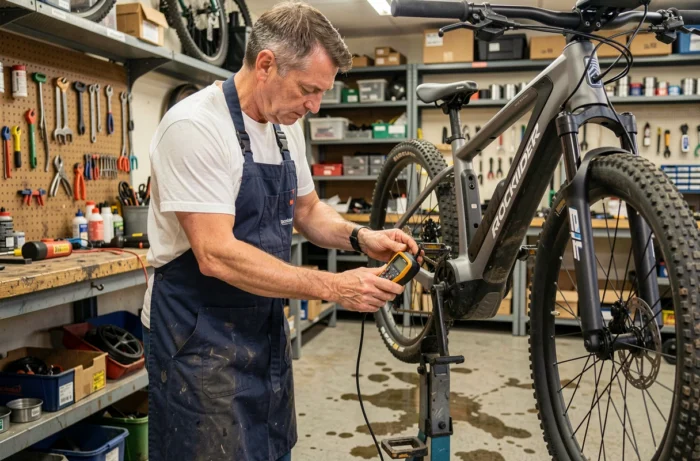
If the display doesn’t turn on at all, the battery may be the cause. Before assuming there’s a fault, check two simple things: that the battery is locked into its mount (you should hear a clear click) and that the connector is in good condition. A loose connection at the mount can cut off all power.
The compatible charger listed by Decathlon for the E-ST 100 delivers 36 V. If the battery no longer charges, try another compatible charger first before suspecting the battery itself.
Gradual loss of range
A battery that used to last for several dozen kilometres but now only manages half that distance isn’t necessarily at the end of its life. Tyre pressure affects range: Decathlon recommends inflating the original inner-tube tyres to between 1.0 and 1.8 bar. Underinflated tyres increase rolling resistance, making the motor draw more power from the battery to compensate.
Other factors can reduce range even when the battery is working properly:
- Using mode 3 almost exclusively, which puts the motor under maximum load and drains the battery much faster than modes 1 or 2
- Low temperatures (below five degrees, lithium cells lose some of their discharge capacity)
- A dirty pedal-assist sensor, which sends erratic signals to the controller and causes unnecessary power surges
Motor locking up or vibrating: diagnose before replacing it
Some users report a motor that locks up mechanically or produces unusual vibrations while pedalling. It’s easy to assume the motor itself is at fault, but several external causes can produce the same symptoms.
The pedal-assist sensor, located by the bottom bracket, detects pedal rotation to activate the assistance. If the sensor is dirty, misaligned or damaged, it sends inconsistent information. The motor receives conflicting commands, causing vibrations or intermittent lock-ups.
Checks to carry out before visiting a workshop
Before taking the bike to a workshop, you can follow these steps:
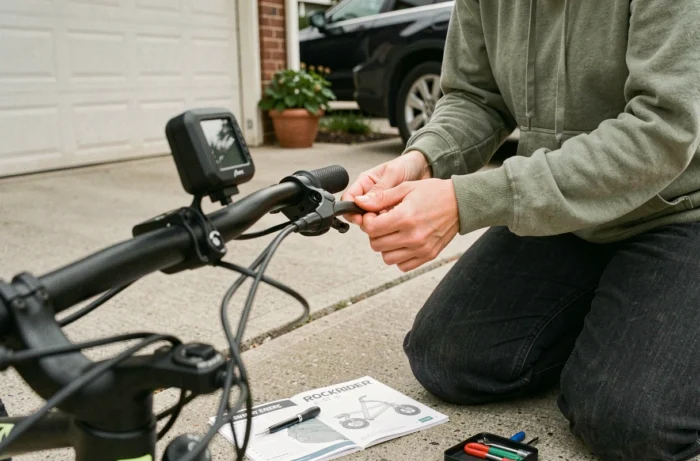
- Clean the area around the pedal-assist sensor with a dry cloth, avoiding harsh solvents, and check that the magnet on the sensor disc is in place
- Connect the bike to the Decathlon Ride app via Bluetooth to check for any error codes shown on the display or stored in the system
- Turn the pedals with no load (with the bike on a stand) to see whether the assistance activates normally
- Check that the rear wheel axle is tight, as even slight play can cause vibrations that are transmitted to the motor
If the motor still locks up mechanically after these checks, a workshop diagnosis can determine whether the problem lies with the motor, controller or wiring. Replacing the motor alone only makes sense once the other components have been tested.
Decathlon warranty and E-ST 100 versions: what changes by model year
One point that forums often overlook: components vary by year of manufacture. The 2023 Rockrider E-ST 100 and the model sold in 2020 may not have the same controller, firmware or diagnostic procedures. Following a guide intended for a different model year can lead to an incorrect diagnosis or even damage a component.
To identify the exact version, find the product reference number on the purchase receipt or frame label, then consult the corresponding manual on the Decathlon support website.
Warranty coverage
The warranty covers manufacturing defects, but not wear and tear from normal use. A motor that has clocked up several thousand kilometres exclusively in mode 3 may not be covered, as some users have reported. Keep your proof of purchase and document the symptoms (photos, screenshots from the Decathlon Ride app) to strengthen your case if there’s a dispute with the workshop.
A step-by-step diagnosis is the best approach when your Rockrider E-ST 100 develops a fault. An overheating controller, a dirty sensor or a battery that isn’t properly clipped in requires a different fix from a faulty motor. Taking the time to check each component before visiting a workshop helps avoid unnecessary replacements and speeds up repairs when they’re needed.