Real estate ownership on a global scale encompasses very different realities depending on whether we measure agricultural land areas, the value of a portfolio of commercial properties, or the volume of assets managed on behalf of third-party investors. Identifying the largest real estate owners in the world first requires distinguishing these three categories, which rarely overlap.
Land ownership, real estate wealth, assets under management: three distinct realities
An Australian rancher who owns over a million hectares of pastureland does not appear in the same rankings as a Spanish billionaire accumulating office towers in Chicago or London. The ranking depends on what is being counted: land area, market value of a built portfolio, or volume of real estate assets under management.
Lists of major landowners measure areas. Those that focus on real estate fortunes assess the value of assets or investments. Institutional surveys, such as the one published by Institutional Real Estate, Inc., list real estate assets under management, meaning that the companies mentioned do not necessarily own the properties outright.
This confusion fuels misleading comparisons. An institutional manager may weigh more in volume than a billionaire in personal wealth, as indicated by data compiled by Breizheo real estate on the issue of the most significant global real estate owner.

Amancio Ortega: the largest private real estate owner in the world
The founder of Zara holds, through his investment company Pontegadea, the largest private real estate portfolio in the world. His strategy is based on a simple yet systematic mechanism: reinvesting the dividends received from the textile group Inditex into prime real estate assets.
The Pontegadea portfolio spans several continents and various types of properties: office buildings, retail spaces, logistics. Ortega’s constant appetite for assets located in major metropolitan areas remains the primary driver of this expansion.
A diversification into infrastructure
Beyond traditional real estate, Pontegadea is now investing in infrastructure. The company has agreed to acquire a 49% stake in the British port operator PD Ports. It has also joined a consortium to acquire the Australian logistics company Qube Holdings.
Ortega is no longer limited to prestigious properties. This extension into logistics and ports reflects an evolution of the model: profitability also comes from controlling significant infrastructures in global trade.
Major landowners: families and ranchers on a continental scale
On the pure land ownership side, the dominant profiles are very different. The largest areas belong to ranching families, industrial dynasties, or members of royal families.
Among the recurring names in the rankings of owned areas, we find:
- The Gunn family in Australia, whose ranching operations cover over a million hectares across the country, through the company Gunn Agri Partners.
- The Irving family in Canada, whose forestry and industrial activities rely on comparable areas.
- The British royal family, whose Crown lands represent a considerable historical heritage, distinct from the personal wealth of the sovereign.
These landowners do not rank among the largest real estate fortunes because the market value of agricultural or forest land remains far lower than that of office towers in global capitals. A million hectares of Australian pastureland is worth less than a skyscraper in Manhattan.
Institutional managers: the invisible weight in global real estate
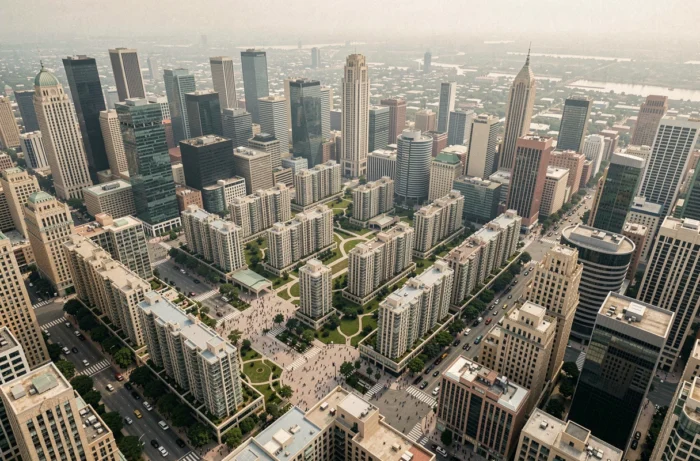
The largest players in global real estate are neither individuals nor families, but institutional managers. These companies manage real estate portfolios on behalf of pension funds, insurance companies, sovereign wealth funds, or private investors.
The annual survey on assets under management (Global real estate AUM), published by Institutional Real Estate, Inc., shows that these managers collectively weigh much more than all the real estate billionaires combined. Their influence on markets, prices, and urban planning in major cities is direct.
Management for third parties and actual ownership
A technical point changes the reading of these rankings: managing an asset does not equate to owning it. When a company manages several tens of billions of euros in real estate assets, it receives management fees, but the properties belong to its clients. The confusion between management and ownership artificially inflates certain rankings.
This is why direct comparisons between an Amancio Ortega, who owns in his own name through Pontegadea, and an institutional manager who administers assets for third parties do not make sense. Both operate on massive scales, but the nature of their control over the properties is fundamentally different.
Geographic distribution of major real estate fortunes
The portfolios of the largest private owners are concentrated in a few specific areas. Ortega targets Western metropolises: Chicago, London, major Spanish cities. Australian landowners occupy low-density rural areas. Institutional managers cover all continents, with an overrepresentation in North America, Europe, and the Asia-Pacific region.
This geographic concentration reflects two opposing investment logics:
- The search for rental yield in high-demand urban centers (offices, retail, luxury residential).
- The securing of land in politically stable countries, where agricultural land retains value over the very long term.
- Investment in infrastructure (ports, logistics), a rapidly growing segment among players like Pontegadea.
The question “who is the largest real estate owner in the world” therefore does not have a single answer. Amancio Ortega dominates private real estate wealth, ranching dynasties hold the largest areas, and institutional managers control the largest volumes of assets. Three answers for three definitions of the word “owner”.