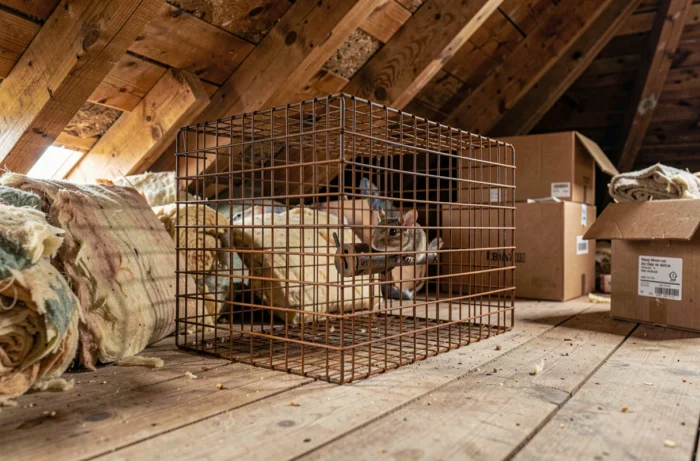
The stone marten is a nocturnal mustelid that settles in attics, lofts, and garages to nest, gnaw on electrical cables, and soil insulation with its droppings. Before purchasing a trap, the first thing to check is neither the size of the cage nor the price: it is the legal status of the animal in your department.
ESOD Status of the Stone Marten: a Mandatory Check Before Any Purchase
The stone marten is part of the Species Likely to Cause Damage (ESOD), but this classification varies from one department to another. Since the 2023-2026 triennial review, about 45 departments still classify the stone marten as ESOD, with capture periods generally allowed from July 1 to March 31.
In departments where the stone marten is no longer classified as ESOD (notably in the south and west), trapping by individuals is prohibited. Only preventive and deterrent measures remain legal. Capturing or killing a stone marten in a non-classified department exposes one to penalties of up to 15,000 euros in fines, according to the legal analysis published by Invazio in August 2026.
The national list of ESOD is also being renewed for the 2026-2029 period, which could change the classification of new departments. Consulting the prefectural decree in force in your department before ordering a stone marten trap available at Brico Dépôt avoids a costly infraction and unnecessary capture.
Live Cage Trap or Jaw Trap: Two Different Capture Logics
The traps sold in DIY superstores are divided into two families that do not respond to the same situations or regulatory constraints.
Live Capture Cage
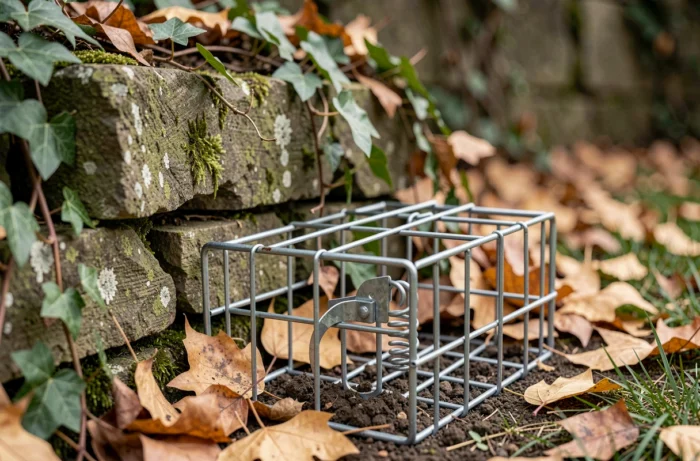
The live capture cage (or box trap) is a gridded device with one or two entrances, equipped with a trigger mechanism by pallet. The animal enters, steps on the pallet, and the door closes without injuring it. This is the only type authorized for unlicensed individuals in most departments classified as ESOD.
The main sizing criterion is length: an adult stone marten measures between 40 and 54 centimeters (body only). The cage must therefore offer at least 60 centimeters of depth so that the animal can enter fully before triggering. A model that is too short causes closures on the tail, which injures the animal and makes capture ineffective.
Lethal Traps and Jaw Traps
These devices kill or immobilize the animal by mechanical pressure. Their use is reserved for licensed trappers, holders of a permit issued by the prefecture after specific training. An individual using a jaw trap without a license commits an offense, even in a department where the stone marten is classified as ESOD.
For a homeowner facing a stone marten in their attic, the live capture cage remains the only legal option accessible without prior training.
Technical Criteria for Choosing an Effective Trap Cage
All cage models may look similar, but three technical parameters separate a functional trap from an unnecessary purchase.
- Mesh and wire thickness: the stone marten has jaws capable of gnawing through plastic and soft wood. Prefer galvanized steel mesh with a wire diameter sufficient to withstand bites. A mesh that is too thin deforms within a few hours.
- Trigger sensitivity: the trigger pallet must react to the weight of a stone marten (between one and two kilograms approximately) without triggering at the passage of a lighter rodent. Some models offer an adjustment screw for tension, allowing sensitivity to be adjusted according to the targeted species.
- Door locking system: once closed, the door must withstand the pushes of the trapped animal. Models with double locks (upper and lower latch) reduce escapes by lifting the trapdoor.
The material of the base also matters. A solid metal base protects the ground from scratches and prevents the stone marten from digging under the mesh to escape.
Trap Placement and Baits: Mistakes That Lead to Failed Captures
A well-chosen trap but poorly positioned remains empty for weeks. The stone marten is a wary, territorial animal with a keen sense of smell. The location and preparation of the trap are as important as the material itself.
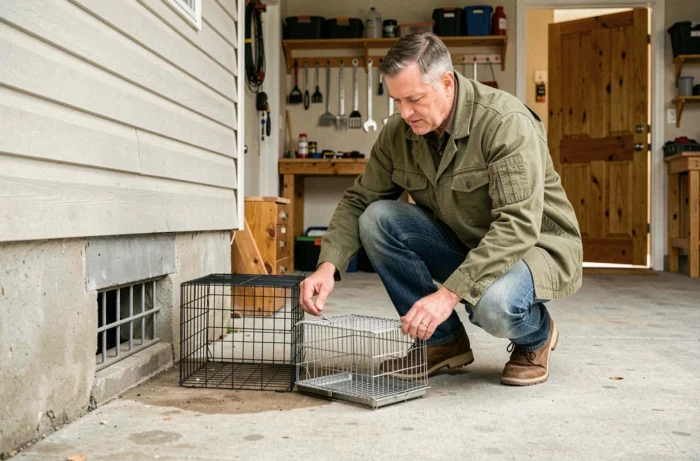
The stone marten follows repetitive paths along walls, beams, and gutters. Identifying these passages (paw prints, elongated dark droppings, musky odor) allows you to place the trap directly on the usual route. A trap placed in the center of an attic, far from the walls, has very little chance of working.
Covering the cage with a dark fabric reduces the animal’s wariness. A shiny metal cage, left bare, is an unfamiliar object that the stone marten will avoid for several nights before approaching. An old sheet or burlap cloth mitigates the artificial appearance of the device.
For bait, a whole egg (raw, unbroken) placed at the bottom of the cage remains the most effective. The stone marten is attracted to eggs and must fully engage in the cage to reach it. Meat or fish-based baits also attract neighborhood cats, which increases empty triggers.
After Capture: Legal Obligations and Release
Once the stone marten is captured alive, regulations require it to be released into a suitable natural environment, several kilometers from the capture site, to prevent it from returning. In departments where the stone marten is classified as ESOD, the trapper must report the capture to the departmental federation of hunters or the DDT (Departmental Directorate of Territories).
Releasing the animal less than a kilometer away is useless: the stone marten knows its territory and will find its way back in a few days. A distant release must be done in a wooded area, far from homes, to limit the transfer of nuisance to another individual.
After the stone marten is removed, sealing all access points (shifted tiles, ungrilled ventilation openings, cable passages) remains the only measure that prevents a new installation. A trap without preventive work only postpones the problem for a few weeks.