
The fashion accessories market is undergoing an unprecedented regulatory transformation in Europe. Between the directive on environmental claims and the regulation on ecodesign, the terms “responsible” or “sustainable” attached to a piece of jewelry, a bag, or a scarf will soon no longer be used without verifiable evidence. This context redefines what it truly means to choose unique and responsible accessories to enhance one’s style.
Environmental Claims on Accessories: What European Regulation Changes
The European directive 2024/825, known as Empowering Consumers for the Green Transition, must be transposed into member states by the end of 2026. Its central principle: prohibit generic terms like “eco-responsible” without evidence covering the entire life cycle of the product. A bracelet made from recycled fibers can no longer claim to be “sustainable” if its dyeing or transport generates undocumented impact.
More specifically, this directive prohibits presenting an accessory as “carbon neutral” or “low impact” when the claim relies solely on external carbon offsetting, such as tree planting outside the value chain. For brands selling bags, jewelry, or belts labeled “green,” the legal risk becomes tangible.
At the same time, the European regulation on ecodesign (ESPR, EU 2024/1781) gradually prohibits the destruction of unsold textiles and clothing accessories by large companies. Brands that produce unique pieces in small series, like the accessories offered by Owly Mary, are structurally less exposed to this constraint as their stock volumes remain limited.
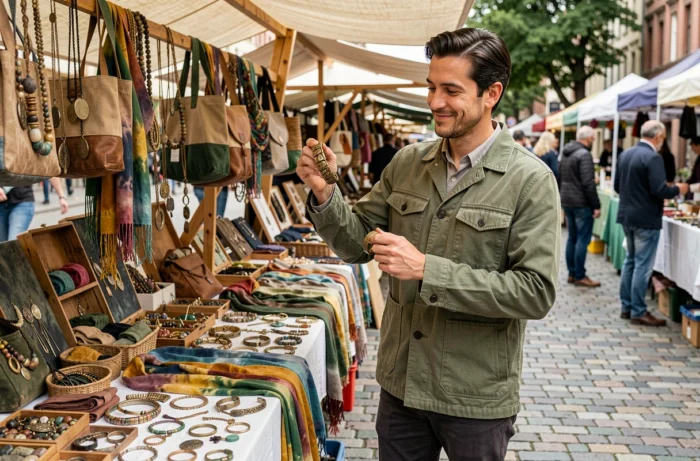
Responsible Accessories: Identifying Reliable Materials and Labels
Claiming that an accessory is responsible requires looking beyond the label. The digital product passport will become mandatory for textile items sold in the European Union. This system, provided for by the ESPR regulation, will allow tracing the origin of materials, manufacturing conditions, and the recyclability of a bag, scarf, or pair of glasses.
While awaiting its generalization, some concrete benchmarks help sort credible claims from hollow slogans:
- An independent third-party label (GOTS for organic cotton, OEKO-TEX for the absence of harmful substances) provides verifiable assurance, unlike a “natural” mention self-declared by the brand.
- Traceability of the supply chain: a brand that can indicate the country of weaving, dyeing, and assembly offers more transparency than a simple “made in Europe.”
- The physical durability of the product: an accessory that withstands several years of daily use mechanically reduces its footprint, regardless of its original material.
Field returns vary on this point: some accessories made from recycled materials have a lifespan comparable to virgin materials, while others degrade more quickly depending on usage conditions. The available data does not yet allow for a general conclusion.
Style and Unique Accessories: Building a Cohesive Look Without Accumulating
Enhancing an outfit with accessories does not come from accumulation. One well-chosen accessory transforms a silhouette more than five layered pieces. A scarf in colors suited to the complexion draws light to the face. A belt visually repositions the waist. A structured bag anchors a casual look.
The responsible logic aligns with stylistic logic here. Buying less, but unique and durable pieces, creates a double effect: a more readable wardrobe and a reduced environmental impact. French creators who work in small series or unique pieces provide access to accessories that cannot be found in fast fashion chains.

Colors and Materials: Two Criteria Before Purchase
Before falling for a piece of jewelry or a bag, two questions suffice to filter the impulse. Does the color harmonize with the majority of the existing wardrobe? Will the material withstand regular use over several seasons?
An accessory worn three times a week for two years has a negligible cost per use, even if it is more expensive to purchase than a disposable equivalent. In contrast, a trendy accessory worn twice before being forgotten at the back of a drawer represents waste, regardless of its price.
Responsible Fashion in France: A Regulatory Framework Advancing in Stages
France was among the first European countries to introduce an extended producer responsibility (EPR) system for textiles and accessories. This system requires market players to finance the collection and recycling of their products at the end of their life cycle.
The ESPR regulation adds an additional layer by imposing ecodesign criteria from the manufacturing phase. For fashion accessories, this ultimately means requirements on the recyclability of materials, the reparability of closures or fasteners, and the limitation of chemical substances.
French artisanal brands that already work with certified materials and short circuits are ahead of these obligations. Their model of production in small quantities naturally limits unsold items, where large retailers will need to adapt their practices to comply with the destruction ban.
- The directive 2024/825 regulates environmental claims starting at the end of 2026.
- The ESPR regulation imposes ecodesign and the digital passport for textiles and accessories.
- The French textile EPR system already finances the collection and recycling of end-of-life accessories.
This evolving regulatory framework is gradually reshaping the contours of responsible fashion. For a consumer wishing to enhance their style with durable accessories, the most reliable reflex remains to prioritize verifiable transparency on materials and manufacturing, rather than generic marketing promises that, soon, will no longer be legally tenable.