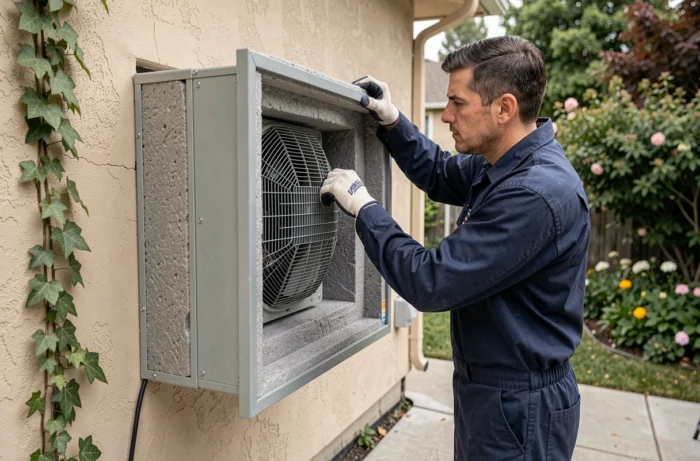
The outdoor unit of an air conditioning system produces a continuous noise that oscillates between the low hum of the compressor and the rush of the fan. Installing a noise-reduction box around this unit seems to be the most straightforward solution. However, a poorly designed box can cause overheating, complicate maintenance access, and in some cases, amplify the noise instead of reducing it.
Overheating and maintenance access: the constraints the box must address before noise
Most articles on the subject discuss the noise-reduction box from the perspective of neighbors and regulations. They overlook a more immediate issue: thermal management. An outdoor unit continuously expels hot air. If the box restricts airflow around the unit, the internal temperature rises, causing the compressor to work harder, which increases consumption and shortens its lifespan.
Several technical feedbacks indicate that an effective box must allow air to circulate freely, with openings sized not to obstruct air inlets and outlets. Models that are closed on five sides without sufficient ventilation create exactly the opposite problem of what is being sought.
Maintenance access is another blind spot. A technician must be able to service the outdoor unit at least once a year for condenser cleaning and refrigerant circuit checks. If the box is not removable or if its panels do not open easily, installing a noise-reduction box for air conditioning complicates every intervention and increases maintenance costs.
In co-ownership, the constraint becomes even heavier. Installing a box on a façade or balcony may require the approval of the general assembly, and some regulations impose aesthetic uniformity that limits the choice of materials and dimensions.
Acoustic design of the box: what truly reduces decibels
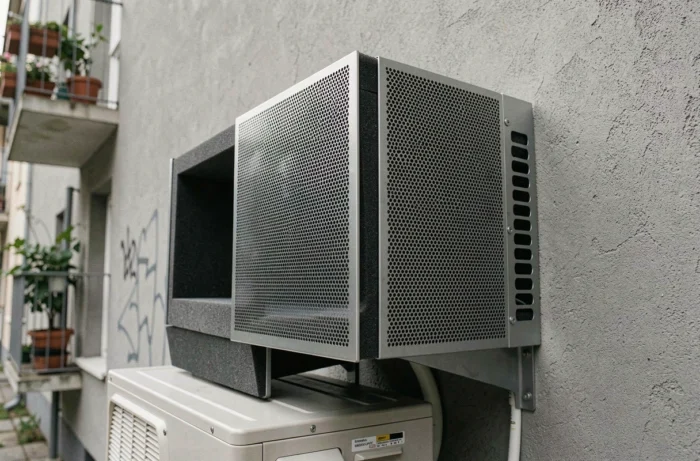
A box is not just a simple enclosure placed around the outdoor unit. Its internal design determines the bulk of its acoustic performance.
Absorbing walls and internal geometry
An internal lining made of absorbing material (acoustic foam, protected mineral wool) captures some of the sound energy instead of reflecting it. Field feedback indicates that parallel walls without treatment create a resonance box effect that can amplify certain frequencies instead of attenuating them.
The addition of internal deflectors, slanted panels that break the direct sound path to the outside, improves attenuation without blocking airflow. This approach is more effective than simply doubling the thickness of the walls.
Actual results: a wide range depending on the installation
Available data shows reductions ranging from about 3 to 17 dB depending on the type of box, the quality of the installation, and the immediate environment. Such a wide gap means that a budget box installed without care may barely make a perceptible difference, while a well-executed installation with absorbing materials and deflectors can halve the perceived sound intensity.
Field feedback varies on this point: some users report a clear improvement, while others notice little change. The quality of the installation and the compatibility between the dimensions of the box and those of the outdoor unit explain a good part of these discrepancies.
Structure-borne noise and anti-vibration pads: the most underestimated lever
The noise from an air conditioning system does not only propagate through the air. The vibrations from the compressor transmit through the support, the wall, the balcony slab, and these structure-borne vibrations can be perceived inside the home as a low hum that the box alone does not eliminate.
Anti-vibration pads or supports placed between the outdoor unit and its support mechanically decouple the device from the building structure. This decoupling reduces the transmission of low frequencies, which pass through walls and floors most easily.
The box itself must also be decoupled. If its feet are in rigid contact with the ground or wall, it becomes an additional vibration bridge. Elastomer pads under the box complete the setup.
- Anti-vibration pads under the outdoor unit to cut transmission to the support
- Soft pads under the box to prevent it from becoming a conductor of vibrations
- Wall fixings with silent blocks if the unit is installed on the façade

Noise-reduction box for air conditioning: concrete selection criteria
Before purchasing or having a box made, checking a few technical points avoids the most common mistakes.
- Integrated ventilation: the box must maintain a sufficient air volume around the unit and not obstruct the blowing grille or the intake
- Maintenance access: at least one removable panel or an entirely removable side, without specific tools
- Internal treatment: acoustic foam or mineral wool with moisture-resistant coating, no smooth and reflective surface
- Dimensions: allow a free space of several centimeters between each wall of the box and the outdoor unit for airflow
- Co-ownership compatibility: check the internal regulations before any installation on the façade or balcony
A box that is too tightly fitted to the outdoor unit restricts airflow and complicates maintenance. Insufficient space between the box and the outdoor unit negates the acoustic benefits by causing additional air turbulence.
Noise barrier or complete box: two distinct approaches
The noise barrier, a panel placed between the outdoor unit and the area to be protected, offers a simpler alternative. It does not enclose the device, poses no ventilation issues, and generally costs less. However, it only attenuates sound in one direction.
The complete box surrounds the unit and reduces noise in all directions. It is the suitable solution when multiple neighbors are exposed or when the unit is installed in a corner that reflects sound. The complete box remains the only option in a reverberant environment, such as an inner courtyard of a building or a narrow passage between two buildings.
The choice between the two depends on the site configuration, not on a technical superiority of one over the other. A well-oriented barrier may suffice in an open garden. A box becomes necessary as soon as sound reflects off nearby surfaces.
The noise from an air conditioning system is never resolved with a single device. The box addresses airborne noise, the anti-vibration pads cut structure-borne transmission, and correct sizing preserves thermal performance. Neglecting any of these three axes means investing in a solution that will only deliver a fraction of its potential.