
Obtaining a French birth certificate from abroad requires identifying the right contact among several administrations. The Central Civil Registry Service in Nantes, consulates, and town halls do not handle the same files, and the processing times vary depending on the chosen channel. Comparing these options can save several weeks on a process that is often urgent.
Processing Times and Channels for Birth Certificate Requests: Comparative Table
The choice of channel depends on a simple criterion: the place of birth and the nationality status of the applicant. Three scenarios coexist, each directing to a different organization.
| Situation | Competent Organization | Request Method | Indicative Processing Time |
|---|---|---|---|
| French citizen born in France | Town hall of the place of birth | Online (Service-Public.fr) or by mail | Several days to two weeks |
| French citizen born abroad | Central Civil Registry Service (SCEC), Nantes | Online form or postal mail | Several weeks (increasing volume of requests) |
| Naturalized citizen born abroad (certificate not yet established) | SCEC after transcription | Mail with supporting documents | Variable, sometimes several months |
The SCEC in Nantes centralizes civil status records of French citizens born outside the territory. Since the health crisis, the number of French citizens registered at the consular registry has steadily increased, which mechanically raises the volume of requests processed by this service.
For individuals born in France but residing abroad, the town hall of the place of birth remains competent. The online request via Service-Public.fr works from any country, provided you have a postal address in France for receipt. You can read on Pharma Planet a detailed point on eligibility conditions based on nationality.
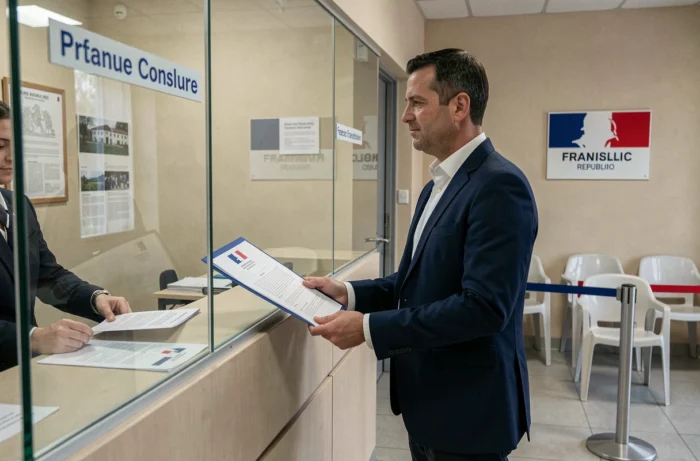
Full Copy, Extract with Parentage, Extract without Parentage: Which Document to Request
The confusion between these three formats generates frequent file rejections. Each administration requires a specific format of birth certificate, and sending the wrong type forces you to restart the process.
- The full copy reproduces all the details on the original certificate, including marginal notes (marriage, divorce, death). It is the most complete document, required for marriage or naturalization.
- The extract with parentage indicates the names and surnames of the parents. It is commonly requested to renew a passport or identity card from abroad.
- The extract without parentage does not mention the parents or marginal notes. It suffices for certain common procedures, but its use remains limited in a consular context.
In case of doubt, requesting a full copy covers almost all situations. The document is free regardless of the format, whether the request goes through the town hall or the SCEC.
Marginal Notes and Updates
A birth certificate is not fixed. Each civil status event (marriage celebrated abroad, divorce, name change) must be transcribed as a marginal note for the document to remain usable. French citizens residing outside France must have their foreign acts transcribed at the competent consulate before they can obtain an updated full copy.
This transcription step is often forgotten. A marriage celebrated abroad but not transcribed will not appear on the French birth certificate, which can block inheritance or tax procedures.
Naturalized French Citizens: A Birth Certificate to Create Before Requesting
For a person born abroad and who became French by naturalization, the French birth certificate does not automatically exist. It must first be established by the SCEC in Nantes, based on the translated and legalized or apostilled foreign birth certificate.
This creation of the certificate occurs after the publication of the naturalization decree in the Official Journal. The time between the publication of the decree and the actual availability of the French birth certificate at the SCEC can extend over several months.
Legalization and Apostille: Two Distinct Regimes
The foreign birth certificate provided as a basis must be authenticated. Two systems coexist depending on the country of origin.
- Countries that are signatories to the Hague Convention use the apostille, affixed by the competent authority of the issuing country.
- Non-signatory countries require consular legalization, a longer procedure that involves the French consulate in the concerned country.
- Some countries benefit from bilateral agreements exempting them from any legalization formalities. The list of these agreements can be consulted on the website of the Ministry of Europe and Foreign Affairs.
An unlegalized or unapostilled foreign document will be systematically refused by the SCEC. Checking the applicable regime for the country of origin before sending the file avoids a postal back-and-forth of several weeks.
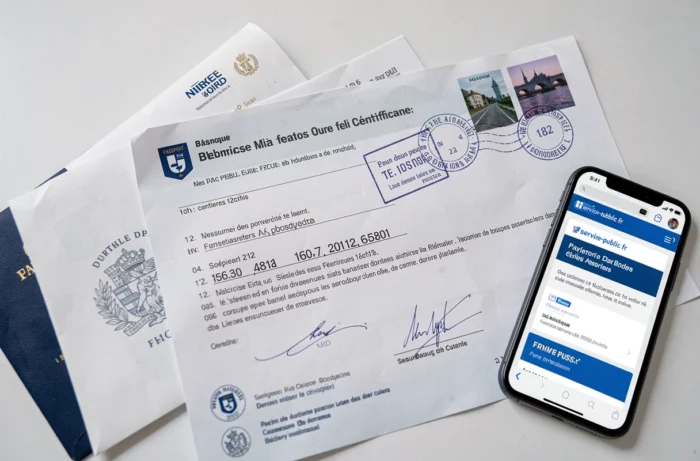
Dematerialization and the French Consular Service: What Changes for Requests from Abroad
The 2026 government report on the situation of French citizens abroad places the dematerialization of civil status among the priorities. The generalization of the French Consular Service, a telephone and digital platform, aims to guide applicants to the right contact without going through the consulate’s switchboard.
This evolution does not eliminate postal mail for receiving documents, but it simplifies the information phase. Secure postal shipments from Nantes to abroad are part of the ongoing expansion measures, which should reduce dependence on a relay address in France.
For French citizens residing in countries where the consular network is sparse, this digital centralization represents a concrete time-saving. However, processing times at the SCEC remain subject to the overall volume of requests, which the dematerialization of the interface does not directly reduce.
The key point to remember is the distinction between the place of birth and the place of residence. It is the place of birth that determines the competent organization, not the current address. A French citizen born in Lyon and living in Japan addresses the town hall of Lyon. A French citizen born in Casablanca and living in Japan addresses the SCEC in Nantes. Confusing these two cases prolongs the procedure by several weeks with no possible recourse.