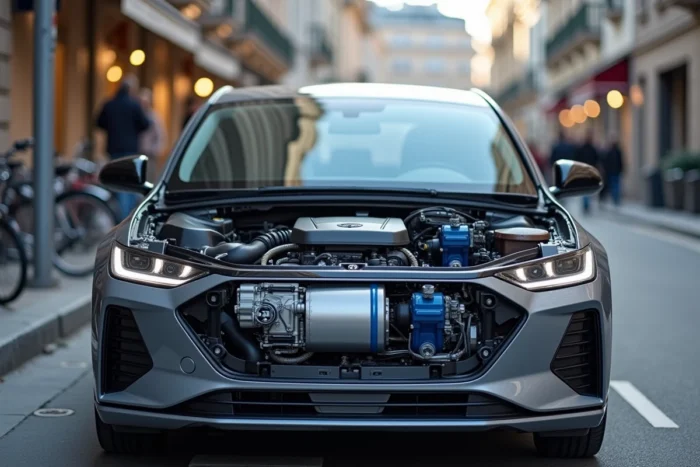
A hybrid vehicle combines two distinct propulsion systems, an internal combustion engine and an electric motor, whose cooperation varies depending on the chosen technology. Behind this general definition, European regulations distinguish three categories with very different implications for CO₂ emissions, taxation, and daily use. Understanding these differences allows us to grasp what the term “hybrid” truly encompasses on a technical sheet.
HEV, PHEV, and MHEV: three hybrid categories with marked regulatory differences
| Category | Plug-in battery | 100% electric driving | CO₂ regulatory classification (EU) |
|---|---|---|---|
| MHEV (mild hybrid) | No | No (occasional assistance) | Enhanced internal combustion vehicle |
| HEV (full hybrid) | No | Yes, for short distances and at low speeds | Enhanced internal combustion vehicle |
| PHEV (plug-in hybrid) | Yes | Yes, with extended range | Rechargeable electric vehicle |
The distinction between these three acronyms goes beyond marketing vocabulary. In calculating the CO₂ emissions targets imposed on manufacturers, only the PHEV is classified as a rechargeable electric vehicle. The HEV and MHEV are still treated as enhanced internal combustion engines, with different fiscal and regulatory treatment.
The PHEV benefits from a utility factor in the WLTP method: the share of electric driving is integrated into the calculation of official emissions. An HEV, even if capable of driving a few kilometers in electric mode, does not benefit from this weighting. To delve deeper into the definition of a hybrid vehicle and its technical nuances, this distinction between rechargeable and non-rechargeable serves as the first criterion for understanding.

Parallel, series, or mixed architecture: what changes in the transmission
Beyond the size of the battery or the possibility of recharging, it is the mechanical architecture that determines how the internal combustion engine and the electric motor collaborate. Three schemes coexist, each producing a noticeably different driving behavior.
Parallel hybrid
The internal combustion engine and the electric motor are both connected to the driving wheels. They can operate together or separately. This scheme is the most common in non-rechargeable full hybrid vehicles.
The electric motor assists the combustion engine during acceleration, then recovers energy during braking to recharge the battery. The driver does not manage anything manually: a computer distributes power in real-time.
Series hybrid
The internal combustion engine never transmits its power directly to the wheels. It operates as an electricity generator that powers the electric motor or recharges the battery. The wheels are driven exclusively by the electric motor.
This scheme allows the internal combustion engine to run at a constant speed, often close to its optimal efficiency. The driving experience is similar to that of a pure electric vehicle, with increased smoothness and silence at low speeds.
Series-parallel hybrid
This architecture combines the two previous logics. The system can operate in series (the combustion engine generates electricity) or in parallel (the combustion engine drives the wheels directly), depending on driving conditions. This configuration is chosen by several manufacturers for their full hybrid models.
- In the city and at low speeds, the series mode prioritizes quiet electric driving and limits fuel consumption.
- On roads and highways, the parallel mode combines both engines to provide the necessary power without excessively taxing the battery.
- During deceleration and braking phases, regenerative braking converts kinetic energy into electrical energy stored in the battery, regardless of the active mode.
Regenerative braking: the mechanism that distinguishes hybrids from traditional internal combustion vehicles
Regenerative braking is often presented as a simple bonus. In practice, it is the central mechanism that makes hybridization viable without external recharging. Without it, an HEV’s battery would drain in just a few minutes of electric driving.
When the driver lifts their foot off the accelerator or brakes, the electric motor reverses its operation and becomes a generator. The resistance produced slows down the vehicle while converting kinetic energy into current stored in the battery. This recovery cycle repeats with each deceleration, creating a loop that maintains the charge without driver intervention.
The efficiency of this system depends on the driving profile. In urban environments, frequent braking maximizes energy recovery. On the highway, deceleration phases are rare, and the internal combustion engine provides most of the propulsion. That’s why a non-rechargeable hybrid vehicle consumes proportionally less in the city than on a fast road, unlike a traditional internal combustion vehicle.

CO₂ emissions and WLTP method: what the official figures really measure
The emission values displayed on the technical sheets of rechargeable hybrid vehicles are based on the WLTP method and incorporate a utility factor. This factor estimates the proportion of driving time spent in electric mode, assuming that the driver regularly recharges the battery.
In real conditions, a PHEV used without frequent recharging consumes as much, if not more, than an equivalent internal combustion vehicle due to the additional weight of the battery. Therefore, the official emissions reflect a theoretical optimal use, not necessarily the daily driving behavior.
- An HEV displays emissions measured over the entire journey in combustion mode, without electric weighting. The figure is more realistic but also higher.
- An MHEV only marginally modifies emissions compared to a standalone internal combustion engine, as the electric assistance is limited to starting and acceleration.
- A daily charged PHEV can drive short distances without consuming fuel, but its balance depends entirely on the driver’s recharging habits.
The European regulatory categorization thus has a direct impact on the published figures. Comparing the emissions of an HEV and a PHEV without considering the calculation method leads to misleading conclusions. The regulatory classification determines the measurement method, not just the taxation.
The choice between these three hybrid architectures boils down to a trade-off between electric range, acquisition cost, and usage conditions. An urban driver who recharges every night fully benefits from a PHEV. A mixed-use without access to a charging station makes the non-rechargeable full hybrid more coherent, as its battery is self-maintained through regenerative braking.