
Creative hobbies hold a unique place in the entertainment offering in France. Neither quite a game nor quite art, they sit at the intersection of manual activity and a shared moment of relaxation. The market has significantly fragmented in recent years, with segmentation by age group, session duration, and usage context (birthday, quiet time, parent-child workshop). This diversification deserves attention to understand what truly works according to different audiences.
Recycled materials and low-tech approach: a discreet but structuring refocus
The most noticeable change in recent creative hobbies concerns the materials themselves. Several specialized sources now recommend starting with what is already available at home: cardboard, scraps of paper, string, stickers.
This refocus on inexpensive and easy-to-store supplies changes the game. It lowers the entry barrier for families who were hesitant to invest in expensive kits. It also allows testing an activity without commitment, then gradually adding more specific materials if interest is confirmed.
By browsing the activities offered by Trop Facile, one can gauge the variety of activities accessible without sophisticated equipment. The logic is the same: start with the simple and move towards the structured, without forcing the initial investment.
This low-tech approach raises a question that creative hobby catalogs often avoid: does an all-in-one kit really provide more than a roll of kraft paper and a few well-chosen markers? For children under six, the framework imposed by a kit sometimes leads to more boredom than enthusiasm, while free materials allow for more exploration.
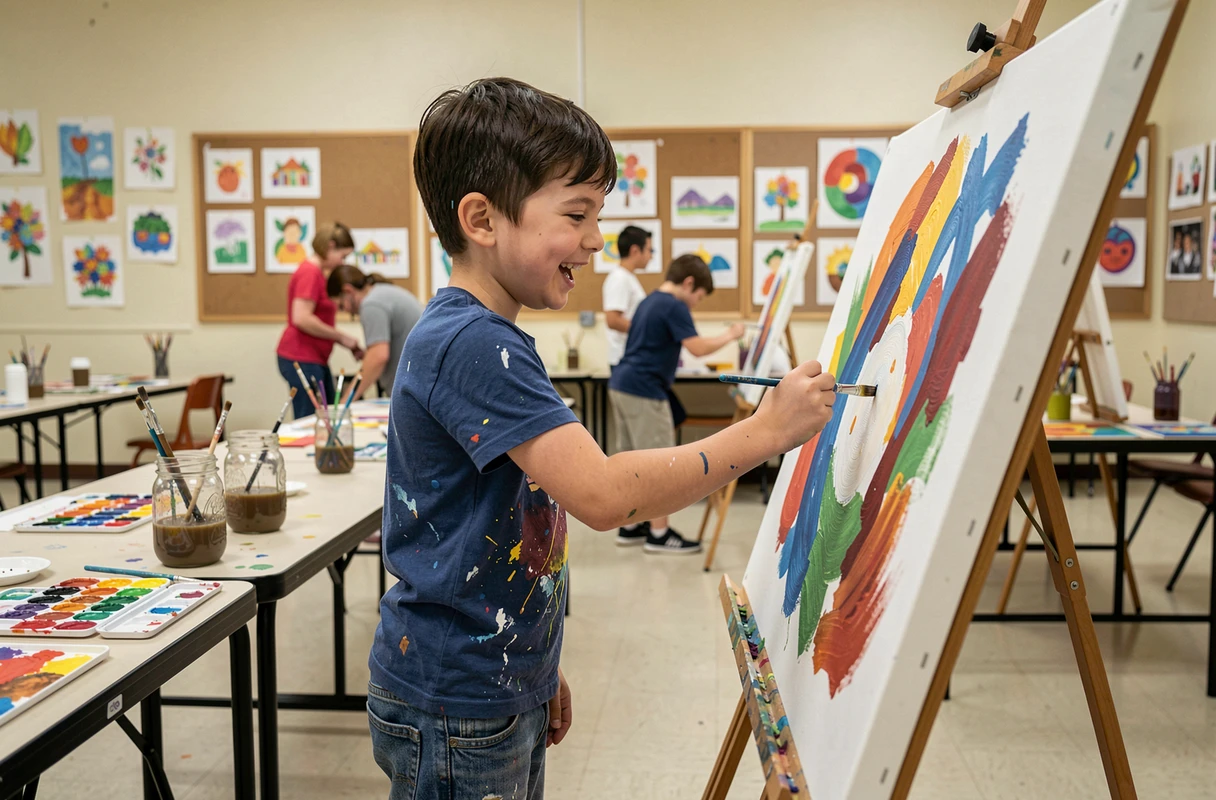
Duration of creative workshops by age: what short formats change
The most practical content on manual activities for children converges towards a clear recommendation: sessions of 20 to 45 minutes for the youngest. This calibration is not arbitrary. It corresponds to the actual attention span of a child aged three to six on a manual task not guided by a screen.
Offering a two-hour painting workshop to a four-year-old almost guarantees a chaotic end to the session. Short formats, with a quickly visible result, maintain motivation. A blind drawing, a collage on cardboard, a small sculpture in modeling clay: these projects completed in half an hour provide an immediate sense of accomplishment.
Adapting complexity rather than duration
For older children (eight years and up) and adults, the question shifts. Duration matters less than the perceived level of difficulty. A too-simple bead bracelet bores a preteen. An overly ambitious embroidery kit discourages a beginner adult.
The right creative hobby is one whose difficulty matches the actual level of the practitioner, not their theoretical age. The indications “from 6 years old” on kits remain approximate and do not take into account prior experience or individual fine motor skills.
Group creative activities: when play takes precedence over crafting
The boundary between creative hobbies and collective play is blurring. Hybrid formats are gaining ground:
- Blind drawing, where each participant draws without looking at their paper and then compares results, transforms a solitary activity into a moment of collective laughter
- Timed challenges (building the tallest cardboard tower in five minutes, for example) add a light competitive dimension that rekindles attention
- Collective illustrated stories, where everyone draws a scene and then passes it to the next, combine storytelling and visual creation
These formats work well for both children’s birthdays and adult gatherings. They require almost no specific materials. The structured playful framework replaces the prefabricated kit and often produces a more lasting engagement in the session.

Intergenerational creative hobbies: what works and what doesn’t
The idea of sharing a manual activity among grandparents, parents, and children is appealing on paper. In practice, gaps in motor skills and patience create frustrations if the activity is not chosen carefully.
Activities that work well intergenerationally share a common point: each participant can contribute at their level without compromising the final result. Collaging on a large format (collective mural, paper mosaic) is a good example. Everyone cuts, glues, and arranges at their own pace. The result is the sum of contributions, not a competition for precision.
What works less well
Shared canvas painting often generates tensions when an adult “corrects” a child’s work. Sewing, despite its warm image, requires a minimum technical level that excludes younger participants. Perler beads, very popular, pose a scale problem: a four-year-old and an adult do not work on the same grid.
The available data does not allow us to conclude that one type of activity is universally suitable for all ages. The choice depends on the specific group, its habits, and the patience of the oldest participant as much as that of the youngest.
Choosing a creative hobby: the criteria missing from product sheets
The product sheets for creative kits indicate the age range, content, and sometimes the estimated duration. However, three parameters are notably absent:
- The level of tidying up and cleaning after the activity, which conditions the actual frequency of practice (acrylic paint on a beige carpet, for example, will likely only be attempted once)
- The reusability of the provided materials: some kits contain just enough supplies for a single project, making them a one-time purchase
- The possibility of extending the activity beyond the kit, with common materials, which transforms a one-time purchase into regular practice
A reusable and moderately messy kit will be used ten times more often than a spectacular but constraining box. This pragmatic criterion weighs more, over time, than the originality of the concept or the quality of the visuals on the packaging.
The choice of a creative hobby benefits from being guided by the actual constraints of the household (space, cleaning time, tolerance for mess) rather than the allure of novelty. Activities that settle sustainably into a family routine are rarely the most impressive upon unboxing.