
The engine no longer shuts off at red lights, the wrench warning light remains on, and the message “stop and start to be checked” appears on the dashboard of the Clio 4. Before rushing to the mechanic, one can already identify the source of the problem by observing the overall electrical behavior of the car.
The stop and start system of the Clio 4 doesn’t fail without warning: it sends discreet signals well before the clear alert.
Stop and start cut-off Clio 4: when the system deactivates without being faulty
We regularly see Clio 4 owners worrying because the stop and start refuses to cut the engine when stopped. In many cases, the system is doing exactly what it should: it is holding back.
The ECU intentionally disables the stop and start when certain conditions are not met. Engine not yet at temperature, battery insufficiently charged after several short trips, high electrical demand (ventilation, defrosting, headlights): the system is protecting itself, it is not faulty. We drive normally, the start remains strong, no warning lights come on.
The real alert is when the message persists with the engine hot, battery charged, and without any particular electrical consumer. At this stage, we shift from normal behavior to a real symptom. To better identify the symptoms of the stop and start to be checked on Clio 4, one must observe the overall context rather than just the message on the dashboard.

Electrical signs revealing a battery or alternator problem
The stop and start that no longer works is rarely an isolated symptom. On the Clio 4, the first instinct is to look at the overall electrical behavior of the car, not just the dedicated warning light.
Tired battery: the clues before the message
A dying battery manifests itself through slower starts in the morning, headlights that dim slightly at idle, or a car radio that resets after a night of parking. These micro-symptoms often precede the appearance of the “stop and start to be checked” message by several weeks.
The IBS (Intelligent Battery Sensor), mounted on the negative terminal, continuously monitors the voltage and current of the battery. When it detects values that are too low or inconsistent, it orders the system to be deactivated. A battery that still allows the engine to start may very well be too weak to guarantee an automatic restart at a red light.
Point not to be overlooked: the Clio 4 requires an AGM or EFB type battery depending on the engine. Installing a standard classic battery disables the stop and start even if it is new. Feedback varies on this point depending on the garages, but the type of battery remains a priority diagnostic criterion.
Alternator: the symptom that is confused with the battery
An alternator that charges poorly produces effects similar to a tired battery. The difference is noticeable over time: with a failing alternator, the problem worsens while driving (the battery drains instead of recharging), whereas a tired battery partially recovers after a long trip.
A concrete sign: if the stop and start message appears while driving after a trip of several dozen minutes, the alternator becomes the main suspect. A diagnostic scan allows reading the charge voltage and quickly determining the issue.
Brake pedal sensor and hood switch on Clio 4
Online content talks a lot about the battery and alternator, but two less publicized components can block the stop and start without causing any other visible symptoms.
Brake pedal travel sensor
The stop and start needs to know when the brake pedal is pressed to decide to cut the engine. If the pedal travel sensor sends an erratic or absent signal, the ECU refuses to activate the system.
What makes this defect sneaky: the car brakes normally, the brake lights may work (they depend on another switch), and nothing suggests a braking problem. Only the stop and start remains inactive. A diagnostic scan then reveals a fault code related to the brake sensor, not the stop and start system itself.
Hood switch
Less known still, the hood switch plays a safety role. The ECU does not allow the stop and start if the hood appears to be open. A dirty switch, poorly repositioned after an engine intervention, or one whose wiring has become loose can be enough to neutralize the system.
Elements to check when the stop and start remains inactive for no apparent reason:
- Condition and cleanliness of the hood switch (accessible without tools, located at the front of the engine compartment)
- Signal from the brake pedal travel sensor via a diagnostic scan
- Battery terminals: a corroded terminal disrupts the reading of the IBS sensor and skews the entire electrical diagnosis
- Presence of multiple fault codes, which point towards a grounding or wiring issue rather than an isolated component
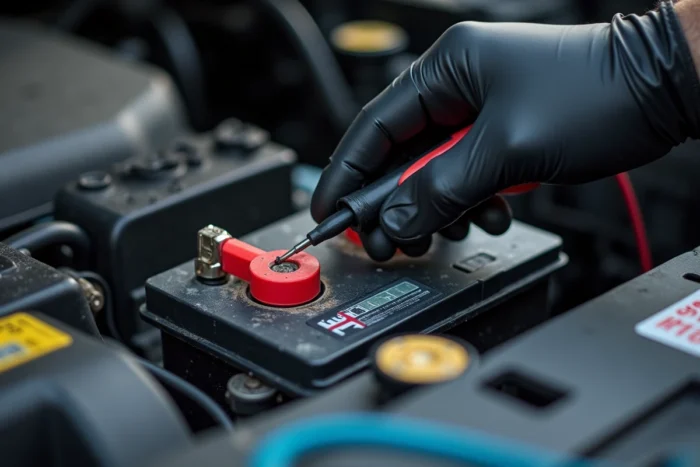
Clio 4 diagnostic scan: reading the stop and start fault codes
A diagnostic scan remains the most reliable way to differentiate the causes. On the Clio 4, multiple fault codes can coexist without any apparent link between them, complicating diagnosis by ear or with a multimeter alone.
A code related to the IBS sensor, another to the EGR valve on diesel versions, a third to the braking circuit: these combinations are common and often point towards a common grounding issue or unstable power supply rather than three distinct faults.
After replacing a battery or a sensor, resetting the ECU is mandatory. Without this step, the message “stop and start to be checked” persists even if the new part is functioning. Some public auto centers do not always have the scan tool compatible with the Renault protocol, which explains the reports from owners whose message remains displayed after intervention.
The most useful diagnosis is not to find out which component is dead, but to understand if the problem is temporary (discharged battery, dirty switch) or structural (failing alternator, degraded wiring). This distinction guides the budget: a cleaned terminal or a repositioned switch costs a few minutes, while an alternator or a reinforced starter represents a whole different investment.